
From Airfinity’s curated analysis of various health and media sources, the US CDC, and the ECDC (European Centre for Disease Prevention and Control) Weekly Communicable Disease Threats Report:
- H5N1-infected dairy herds continue to be reported across the US.
- Two cases of A(H5N1) infection have been reported in Cambodia in two children living under the same roof.
- In Europe, the lowest number of highly pathogenic avian influenza (HPAI) cases in poultry and wild birds has been recorded since 2019/2020 and the risk to the general public remains low.
- COVID-19:
- The disease burden in Japan has been steadily increasing, not so much in terms of hospitalization rates.
- Following a period of very low SARS-CoV-2 circulation, there is evidence of increased COVID-19 activity since May in several EU/EEA countries, especially among people aged 65 years or more.
- Vaccination continues to be protective, with stronger protection against more severe disease, although this protective effect wanes over time. Vaccine protection of individuals at high risk of severe outcomes (such as older people) remains important.
- The currently circulating and largely dominating SARS-CoV-2 variant in Europe is BA.2.86, including subvariants carrying R346T and/or F456L mutations, often referred to in the media as FLiRT. These variants are not expected to be associated with increased infection severity or to significantly reduce vaccine effectiveness.
- Two new cases of human infection with influenza A(H1N2) variant (v) virus of swine origin have been reported in Pennsylvania, US. Both persons had attended the same event where pigs were present. Swine influenza A(H1N2)v cases have previously been reported sporadically in the US since 2021. Overall, 29 cases have been reported globally since 2019. Human infection with influenza virus of swine origin is rare, but sporadic infections may occur in individuals exposed to infected animals as in the two cases above.
- On 8th July, France reported an autochthonous case of dengue in the region of Occitania.
- ECDC map of cumulative number of cases of dengue worldwide in the period March-May 2024:
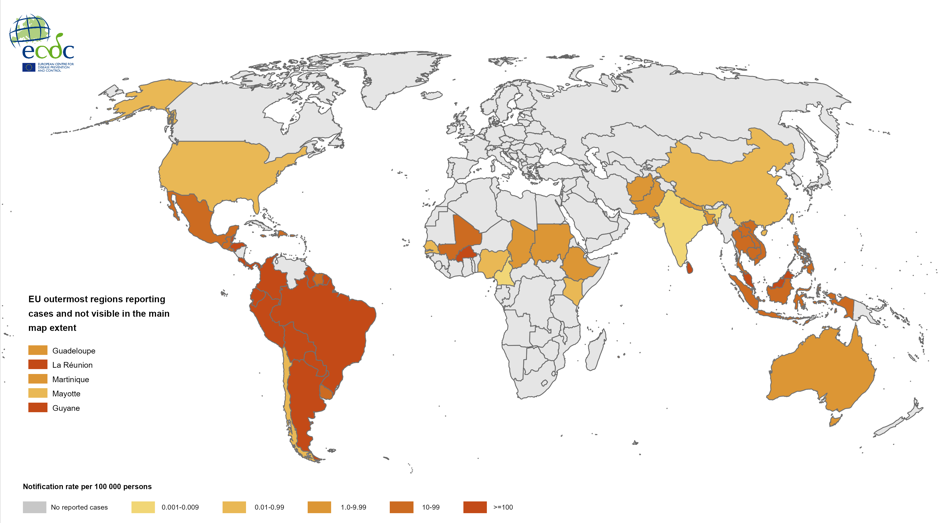
- Cases of Oropouche virus disease in travellers returning from Cuba have been reported in Italy and Spain. The risk of infection for travellers to Cuba is considered low by the ECDC, provided public health authority instructions on the use of personal protective measures against midge and mosquito bites are followed. Outbreaks of Oropouche virus disease have been reported in humans in Central and South America and specifically in the Caribbean; the first such outbreak in Cuba has been ongoing since May with no reported severe or fatal cases for over a month.
- Oropouche virus disease is a zoonotic disease caused by the Oropouche virus (OROV). Mammals (primates, sloths) and perhaps wild birds are considered to be OROV’s natural hosts.
- The main vector of the virus is the Culicoides paraensis midge, which is widely distributed in forested areas and around water bodies in the Americas, but absent in other continents. More about this little fly here https://en.wikipedia.org/wiki/Midge and here https://pubmed.ncbi.nlm.nih.gov/37088353/
- In humans, Oropouche virus disease can manifest as a dengue-like acute febrile condition, and rarely with haemorrhagic complications and meningitis. There is no specific treatment or vaccine for Oropouche virus disease. No direct transmission of the virus from human to human has been documented.
- Since January 2024 over 200 thousand cholera cases have been reported worldwide (including 1,955 deaths), namely in western, eastern and southern Africa, Asia and Central and South America.
- Victoria, Australia, has expanded vaccination eligibility as cases of mpox rise. South Africa has announced increased mpox recovery rates due to an emphasis on early diagnosis and treatment.
- The Paris 2024 Olympic and Paralympic Games will take place from 26th July to 11th August 2024 and from 28th August to 8th September 2024, respectively. The ECDC will be monitoring these mass gathering events through epidemic intelligence activities.
A selection of articles of interest:
- Food (and other) allergies
Especially for our non-medical colleagues here is a great JAMA (Journal of the American Medical Association) Patient Education page on a relevant topic for commercial aviation – food allergies:
And here is a specialist review on inflight allergies by Kodoth SM, Alves P, Convers K, Davis K, Chang C; Infectious Diseases and International Travel Committee of the ACAAI: https://pubmed.ncbi.nlm.nih.gov/35977658/
The authors looked at the use of epinephrine (adrenaline) during in-flight allergic events between 2017 and 2019. In a total of 140,579 in-flight medical events (IFMEs) studied, 3% were identified as allergy-related. Of these, epinephrine administration was recommended by ground based medical services in 398, i.e. in less than 10%. This translates into an incidence of severe in-flight allergic emergencies requiring epinephrine of 0.08 cases per million passengers or 12.5 million passengers for 1 event. The authors concluded that IFMEs requiring epinephrine administration are rare. The risk for epinephrine administration is higher in passengers older than 12 years and is associated with significantly higher rates of flight diversion, hospital transport, and involvement of medical volunteers. Peanuts and tree nuts are the most frequently implicated triggers.
- Dusty regions
Cumulative doses of dust resulting from arrival holding patterns at dusty airports can be detrimental to aircraft engines. Three of the world’s dustiest airports per a recent study are: Delhi (India) in June-August, Niamey (Niger) in March-May, and Dubai in June-August. https://www.flightglobal.com/air-transport/holding-patterns-at-dusty-airports-particularly-detrimental-to-engines-research/159048.article
Think also long layovers at particularly dusty locations (see the darker ringed areas on the map below) at certain times of year.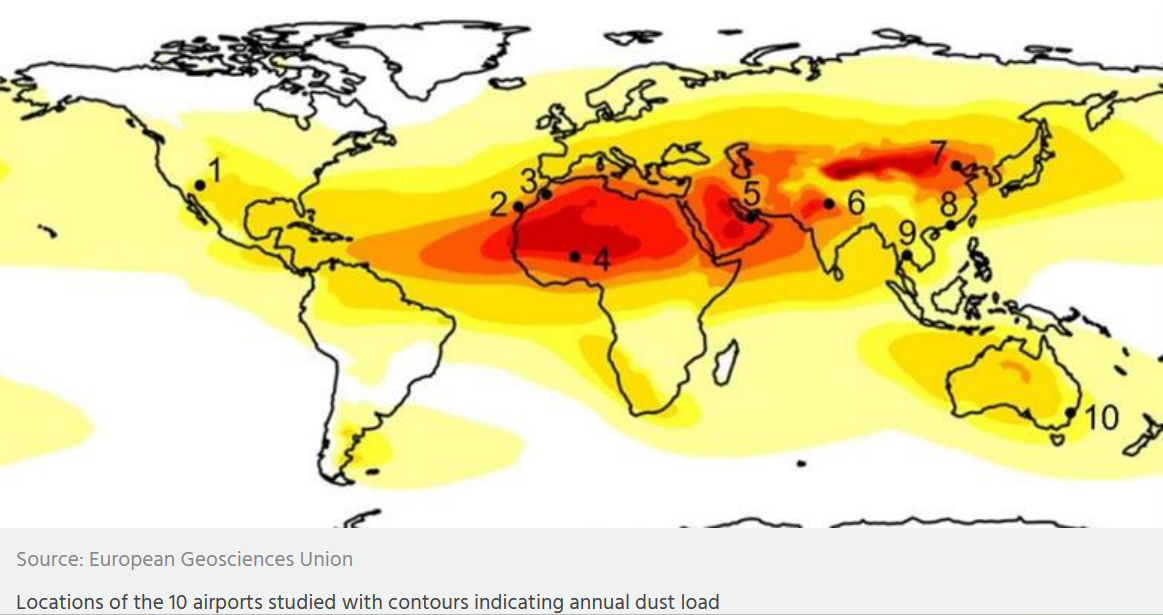
Events:
Two back-to-back major event in Lisbon (Portugal) early October:
- EARLY BIRD DEADLINE IS JULY 31ST FOR ICAM 2024 – register now! www.icam2024.com
- Aviation Health Conference – early bird until 7th September: https://quaynote.com/conference/aviation-health-conference-24/
Dr Rui Pombal
IATA Medical Advisor