
COVID-19:
The situation in China appears challenging with rising infection numbers after the abrupt relaxation of many restrictions - including releasing cities from lockdowns, people being able to quarantine at home on some occasions and not being required to present negative tests at public venues. Current official case and death numbers are implausibly low. It is not clear how severe the impact of the current wave will be, because China’s immune landscape in China is so different to anywhere else, but deaths are expected to increase in coming weeks as case numbers surge. It is noted that while this carries risk of new variants, the different immune landscape in China reduces the likelihood of a new variant that is able to outcompete Omicron. The Chinese situation is discussed in Nature here https://www.nature.com/articles/d41586-022-04502-w
There have been rising case numbers in Brazil, France, Italy, Canada and USA with a preponderance of BQ.1 and derivatives amongst the new cases. In some of those areas, the case numbers may have peaked; deaths have also increased in most of those countries and in some others including Australia and Japan. It appears that the increased immune evasion of BQ.1.1 is not accompanied by increased disease severity.
In the “variant soup” the other top flavours seem to be BQ.1.1 and XBB. Other potential new entrants include CH.1.1 (a derivative of BA.2.75), XAY (a recombinant of Delta with Omicron BA.5, appearing in Denmark and South Africa), XBF (a recombinant of BA.5.2.3 and C.J.1, growing quickly in Australasia), and BW.1 (a derivative of BQ.1, growing quickly in Mexico).
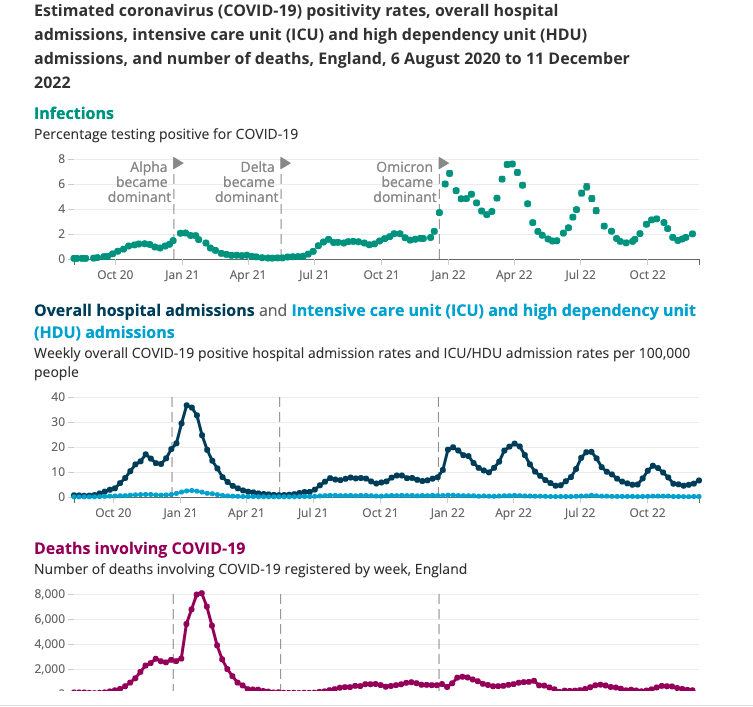
This graphic from the UK Office of National Statistics provides a very useful and encouraging long-term context to the current situation there (likely to be reflective of many other Western countries), looking at trends in test positivity, hospitalisations and deaths over time since late 2020.
A Commonwealth Fund study estimates that in the US, vaccination against COVID-19 has prevented over 18 million hospitalisations and over 3 million deaths: https://www.commonwealthfund.org/blog/2022/two-years-covid-vaccines-prevented-millions-deaths-hospitalizations
Paxlovid lowered risk of hospitalisation and death in this outpatient-based US study: https://www.acpjournals.org/doi/10.7326/M22-2141
Other outbreaks:
There were no new Ebola cases in Uganda in the last two weeks according to WHO.
Cholera outbreaks continue in Syria, Lebanon, Haiti and a number of African countries, including 13000 cases in Malawi.
While dengue rates have declined in a number of Asian countries, Airfinity rates the risk of dengue outbreaks in 2023 as high.
In Canada, paediatric hospitalizations for seasonal influenza have reached more than ten times the normal rate for this time of year. The vast majority of flu samples gathered have been A(H3N2) — a subtype that is more severe than other common strains and is less susceptible to vaccines.
Similarly in UK, influenza is 8 times greater than usual for this time of year, and this coincides with the outbreak of scarlet fever and other Group A strep infections, which have caused a number of childhood deaths, in addition to high numbers of RSV infections.
Simultaneously, RSV is causing large numbers of hospitalisations in North America this season, especially in pre-schoolers and older adults.
A note about GSK and Pfizer racing to produce a vaccine against RSV, here: https://www.nature.com/articles/d41586-022-04434-5
Something completely different to close with (so to speak) – a demonstration of how readily aerosols spread from toilets which are flushed with the lid open: https://www.inverse.com/innovation/toilet-particles-plume-experiment
Best wishes for the season to all; I expect to send the next update some time around New Year.
Best wishes,
David Powell
IATA Medical Advisor